

Accreditation can open a funding door. It cannot tell a student whether walking through that door is worth the price.
That is the accreditation paradox in beauty education: a credential associated with institutional standards can be treated in a sales conversation as evidence of personal economic value. Those are not the same thing. A school’s eligibility to receive federal student-aid funds is not a warranty of affordable tuition, successful licensure, manageable debt, or sustainable earnings.
The public deserves a better conversation than “Are you accredited?” followed by “Financial aid is available.” The better conversation starts with the work a student wants to do—and ends with written costs, financing obligations, and clearly defined results.
November 4 reader update: This edition pairs a new public infographic with the current FSA explanation. It makes no national estimate of flagged beauty schools and no school-by-school earnings ranking.
The paradox is in the federal system’s own explanation
Recognized accreditation is generally one requirement for Title IV eligibility, alongside other conditions including state authorization and Department approval. It is not sufficient by itself. Federal Student Aid’s 2026–27 institutional-eligibility handbook explains those separate requirements.
Meanwhile, FSA’s FAFSA lower-earnings indicator identifies institutions whose graduates’ median earnings fall below the relevant high-school-graduate benchmark. FSA expressly says this informational indicator does not itself affect Title IV eligibility or participation. An earnings warning and aid eligibility can therefore coexist. Read FSA’s announcement and March 23, 2026 update.
Here is the irony: access to financing can remain available while the same federal information system asks students to look carefully at historical earnings. The inconsistency is not that these measures secretly mean the same thing. It is that a reassuring funding credential can be mistaken for an answer to the student’s financial question.
The warning is institution-level, not a prediction for an individual or a specific beauty program. It is not an exam-failure, placement, or graduation rate. It deserves investigation—not dismissal and not exaggeration.
Compliance is a process. Value must be demonstrated.
Accreditation involves standards and review; describing those processes does not establish that a particular education is worth its price. Paperwork, review, and eligibility are inputs to oversight. Skills, completion, licensure, cost, debt, and earnings are the evidence students need to assess their own decision.
Calling the burden a “Title IV compliance tax” is an editorial critique, not the name of a literal tax. The fair question behind it is sharp: what demonstrable student benefit justifies the administrative expense? This article does not assign a dollar amount to that burden or claim every school seeks accreditation for the same reason.
A badge should start the questions, not end them. The absence of a badge should not end them either.
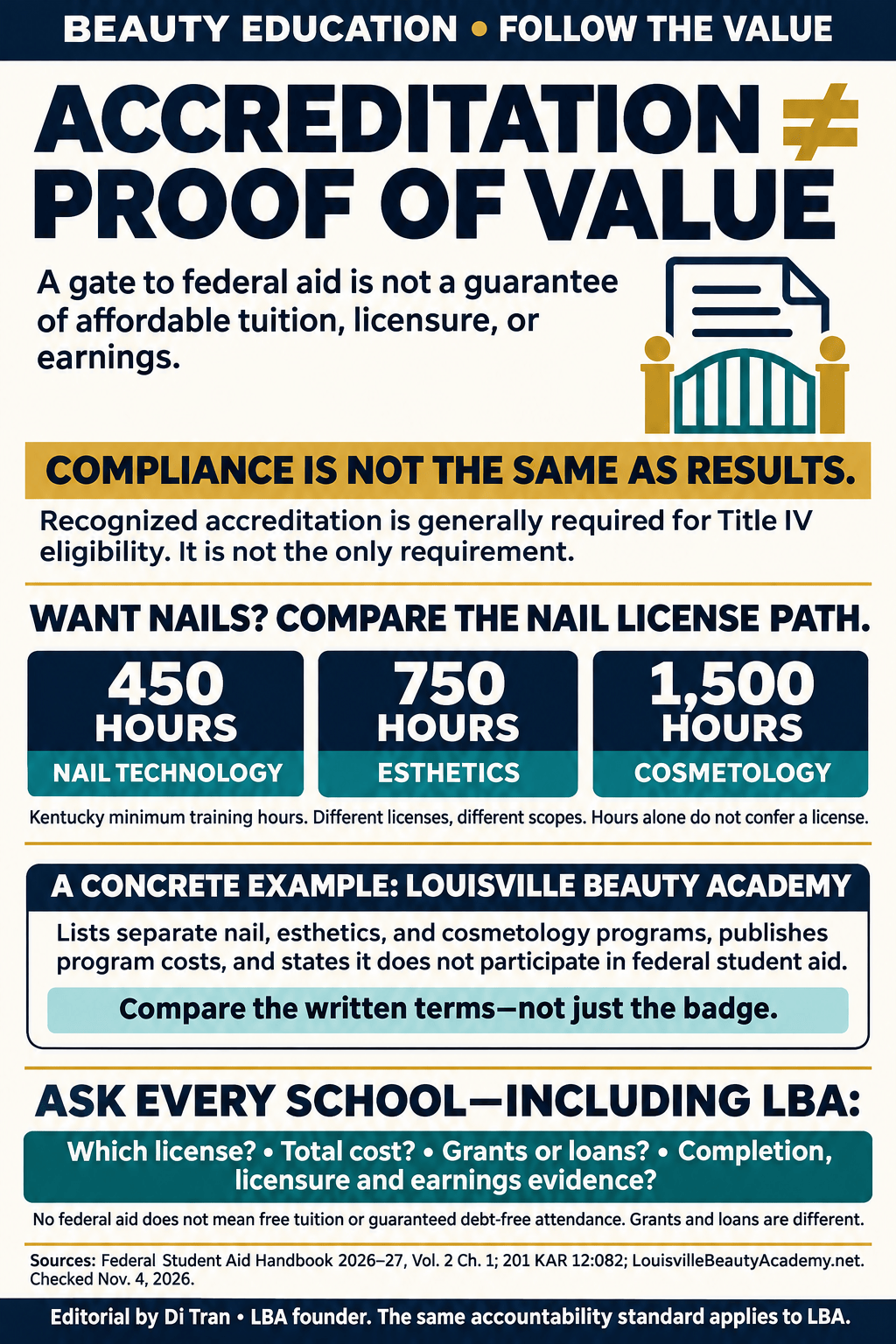
Start with the license—not the longest program
Kentucky’s training regulation establishes different minimum pathways: 450 hours for nail technology, 750 for esthetics, and 1,500 for cosmetology. These are different licenses with different scopes, not interchangeable versions of the same credential. See 201 KAR 12:082, sections 3, 7, and 13.
For someone pursuing nails, the nail pathway deserves an explanation before a broader cosmetology commitment. For someone seeking skincare work, the esthetics pathway deserves the same visibility. A broader program may fit a broader goal; more hours are not automatically a better fit for a narrower goal.
Some accredited schools offer specialty programs. The criticism is not that every accredited school offers only cosmetology. The consumer standard is that every school should distinguish “we do not offer that pathway” from “that pathway does not exist.” Students should not need insider vocabulary to learn their options.
Louisville Beauty Academy: a concrete example to examine
Louisville Beauty Academy’s public website lists separate nail, esthetics, and cosmetology programs, publishes program costs and conditional pricing, and states that it does not participate in Title IV federal student aid. Those are observable disclosures that let a prospective student begin a comparison.
The useful lesson is the structure: make choices and written terms visible. It is not that nonparticipation proves superior outcomes. No federal aid does not mean free tuition, no financial obligation, or guaranteed debt-free attendance. LBA’s conditional prices are not automatic; students should obtain the full charge, incentive conditions, and withdrawal terms in writing. Apply that scrutiny to LBA too.
A loan is financing—not a discount
Federal aid includes different forms of support. Grants generally do not require repayment, subject to exceptions; loans are borrowed money, generally repaid with interest; work-study involves earning money through work. USA.gov explains the distinctions.
Compare the full mandatory price, subtract confirmed nonrepayable support, and then identify what remains payable by the student. Separately record the amount borrowed and its repayment terms. A loan may help pay the bill today; it does not reduce the underlying price.
Include kits, fees, exams, transportation, childcare, and time away from paid work in the decision. Compare written offers. Neither federal-aid participation nor its absence establishes which option is affordable for a particular person.
Make schools show the path from enrollment to outcomes
Ask for counts as well as percentages: how many students started, completed, attempted licensing exams, and became licensed? What period is covered? Who is excluded or unknown? Repeat exam attempts are events, not additional people. A test-taker pass rate does not tell you how many enrolled students reached the exam.
Ask how employment and earnings are measured, including self-employment. Business revenue is not take-home income; self-employment is not unemployment. A credible explanation defines the measure instead of selecting the most impressive number.
The public standard should be simple
- Show the license: connect the student’s intended services to the correct pathway.
- Show the complete price: identify mandatory charges and conditional discounts.
- Show the obligation: separate grants, loans, and payment-plan commitments.
- Show the evidence: define completion, licensure, work, and earnings results.
- Show the exit: explain withdrawal, refund, and transfer terms before signing.
Accreditation is not proof of student value. Demonstrated value requires evidence. That is not an argument against oversight. It is an argument against allowing the language of oversight to substitute for the information a student needs.
Humanizing education means giving people enough clarity to choose—not asking them to trust a badge more than the facts.
Perspective and affiliation: Editorial and consumer education prepared at the request of Di Tran, founder of Louisville Beauty Academy. LBA is an affiliated example, not an independently ranked winner. The same disclosure and evidence standards apply to LBA. School statements are identified as such; no comparative earnings advantage is established. This is not a government finding, endorsement, or individualized legal or financial advice. Sources reviewed November 4, 2026; current regulations and signed school terms control.
Research and public-education design: Di Tran University — The College of Humanization.